Sunday, 28 January 2018

Shallow Water Effects

Any shipbuilding process starts with the owner signing the contract with a shipyard after giving the details of his requirements. Of these, the displacement and speed of the vessel are of utmost importance to the owner. If these requirements do not match with the owner’s specifications, then fine is levied on the shipyard. The shipyard builds the ship. Before the yard delivers the ship to the owner, it performs a lot of tests. One such test is the speed test. The objective of the test is to substantiate that the vessel has met the speed requirements of the owner. However, during the speed trial, the vessel speed is found to be less than the specified speed.
                So, is the shipyard at fault?
   Is there fault in the design?
   What could have gone wrong?
                Well, the answer to this lies in a phenomenon called shallow water effects. Actually, a ship is basically built to operate in deep waters but its speed trials are mainly confined to the shallow water areas which affect its speed.
Image Courtesy- www.google.com

                The reason for the drop in speed in shallow waters is that the water which is flowing just below the ship reaches very high speeds fast due to less water depth. We all know that when the velocity is high at any point in a liquid, there is a corresponding drop in pressure at that point which is explained by Bernoulli theorem. This is the same pressure which provides the upthrust and keeps the ship in floating condition, hence the ships will experience a bodily sinkage and its draft will increase. As a greater surface area is under water the frictional resistance will increase which will cause a drop in the speed of the ship.

                 Also, this drop in pressure is not the same everywhere. It is more in the fore part and less in the aft causing the ship to trim by fore which is an undesirable condition. This is known as ship squat.
Image Courtesy- www.google.com

EFFECT ON WAVE PATTERN


This drop in speed is not the only effect in shallow water, another prominent effect is the change in the wave pattern of the ship and hence the wave making resistance of the ship. Actually, the total resistance of a ship can be divided into frictional and residuary resistance. Wave making resistance forms a major part of the later. 
Image Courtesy- www.google.com

This is the general wave pattern developed when a ship moves through the water. As we can see two sets of waves are generated, transverse waves and diverging waves. The diverging waves are contained in an angle of 19O 28’ called angle of envelope. Let’s see what happens in shallow waters.
The general relation between speed of a wave (v) and wavelength (LW) in deep water is
                     V= (g*LW/2π)1/2
Now for a wave in shallow water,
        V= (g*h)1/2
We can see that the wave has a limiting value in shallow waters, varying with depth, known as critical velocity. When the velocity of ship increases, the angle of envelope increases, till the velocity of ship equals critical velocity, where the angle of envelope becomes 90O. At 90O, the transverse waves disappear.
                Now if the speed is further increased, the wave pattern changes completely. The angle of attack increases and the divergent waves become convergent in nature but no transverse waves are formed. So, there is a major change in the wave pattern. We know that the wave making resistance is dependent on the wave pattern. So, there is a difference between wave making resistance in deep and shallow water.

INTERMEDIATE SPEED


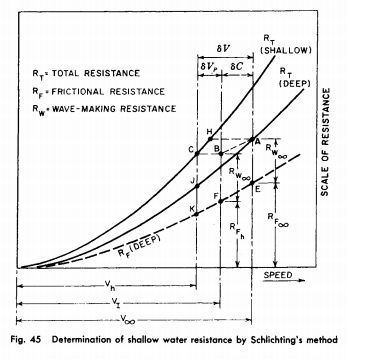
It’s pretty much clear that wave making resistance differs for deep and shallow waters. Let’s say a ship is going in deep waters at a speed V∞.
It will have some wave-making resistance.  When in shallow water the same wave making resistance will occur at a low speed which we call intermediate speed (VI).
This drop in speed is denoted by ΔC= V∞-VI, which is due to the wave making resistance component.
Now the total resistance of the ship in deep waters will be equal to the total resistance of the ship in shallow waters at a further lower speed. We denote this speed as Vh. This drop in speed in shallow water is denoted by ΔVP. This drop in speed occurs due to the augment in the frictional resistance component in shallow water.
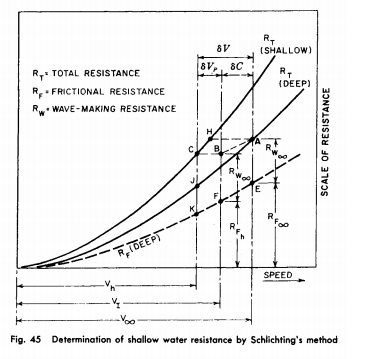
Image Courtesy- Principles of Naval Architecture Volume-2

EFFECT ON TURNING CIRCLE


The diameter of a ship's turn varies with several factors in addition to rudder angle, and water depth is one of them.  For maneuvering, deep water can be assumed when a water depth of more than five times the ship's draught is available. At three times the draught, the shallow-water effects come into action. When depth decreases from twice the draft the effects become more prominent. So, water depth plays a key role in the maneuvering of a ship and if it is neglected it can give wrong interpretations.  The rate of turn depends on the ship's directional stability, and though the rate increases at first on leaving the deep water, it decreases as shallower water is reached. These changes in the rate of turn are comparatively small to be perceived by the ship handler, but in combination with a smaller speed-loss in the turn, as under keel clearance decreases, it results in an increase in the ship's turning-circle diameter.
Image Courtesy- www.google.com

INTERESTING FACTS


• A fishing boat normally can run at 10 knots in deep water. If the water depth is 14 feet, then we can expect a speed loss of about 4%. That means that its speed is reduced by about one-half knot.
• A supply boat is expected to run 15 knots in deep water. However, during sea trials in 20 feet deep water, it did not make this speed. The 14 % typical speed loss means that we would expect a bit less than 13 knots on trial.
• A river workboat is trying to run at 10 knots in 9 ft. of water. It will lose almost a knot and half.

SUMMARY OF WHAT HAPPENS IN SHALLOW WATERS


1.       Ship maneuvering becomes sluggish.
2.       A decrease in ship speed.
3.       Change in the wave pattern.
4.       A decrease in propeller rpm.
5.       Increase in turning circle diameter.
6.       Increase in stopping distance and stopping time.


Article by: Anil Kumar Singh

Saturday, 2 December 2017

Green Ships

Introduction

The plea to have pollution-free vehicles running on the road have been ringing in our ears for quite a long time, without realising that the same applies to the marine environment. Thus the concept of green ships plays a significant role in the life of a naval architect. As much as ships are considered as the most efficient way of cargo transportation, they are also the sources of great pollution in oceanic and marine areas. Indian Maritime Organisation(IMO) has estimated that the Carbon dioxide emissions from the ships are about 2.2% of the global man-made emissions in 2012. The rules that the IMO prescribes for greener ships have been intensifying over the years. Green shipping can incorporate aspects like greener fuel, reducing carbon output and energy wastage, and to reduce the impact on marine life. The efficiency of a ship can be calculated by its EEDI value. Energy Efficiency Design Index (EEDI), formulated for new ships, is an index that estimates grams of CO2 per transport work (g of CO2 per tonne‐mile).   It can be expressed as the ratio of “environmental cost” divided by “Benefit for Society”.

Image Courtesy: Google Images

The lower the EEDI of a ship the more efficient the ship is considered to be. Green shipping technology focuses on reducing the impact of ships on the environment while maintaining a very less EEDI value.

History

 
The history of green shipping goes back to ancient times to the days when men found that floating wood can be used to cross water bodies. From the days when the sailors were on the mercy of the wind to the emergence of an engine coupled with the advances made in power delivery which began with a simple paddle wheel evolving to a single screw propeller and then to a twin screw made the overall efficiency of the power delivered better. From the process of creation of a small explosion inside the cylinder of an engine to the thrust generation required for propulsion of mammoth ships at a speed necessary to run the modern world at a pace never seen before. All this came at a cost. The cost of melting of the polar ice caps, the global increase in average temperature etc. It is only after the Industrial Revolution took place when internal combustion was first used to drive the propellers used on today’s ships. It is a common understanding that the conventional sources of renewable energy like wind, sun and bio-fuels cannot completely replace an internal combustion diesel engine of a ship. So we can actually depend on the more unconventional renewable energy sources like hydrogen or nuclear energy to power the modern day ships and that just might be the way for the shipping industry to pave in the future.

Technology and Steps to be Involved

In lieu of the ever increasing environmental aspects related to pollution, no environmentalist leaves any stone unturned to scrutinize the massive global maritime industry to check their pollution standards and the steps being adapted to minimise it. A ship affects its environment and the pollution of the world’s oceans and atmosphere has become a cause for increasing international concern.


  •           In 1972 the United Nations held a conference on the Human Environment in Stockholm. It was recommended that ocean dumping anywhere should be controlled.
  •           No Ballast Water: Ballast water is needed for safe ship operations but it poses serious ecological, economic and health problems due to the multitude of marine species in Ballast Water. Although IMO developed the International Convention for the Control and Management of Ship’s Ballast water and sediments (BWM), still No ballast water management technique can remove all organisms from ballast tanks while maintaining transverse stability, bow and propeller submergence and reduce windage for adequate manoeuvrability.


    To read more about ballast free ships click the link below


  •         LNG Fuel: Ships used to run on unrefined crude oil full with sulphur and environmentally-harmful impurities. Gas carriers around the world have been using liquefied natural gas (LNG) as part of their fuel source for decades. 

    Norway has been at the forefront of marine LNG applications, dating back to 2000.
    In Stockholm, bunkering of Viking Line cruise ships with passengers on board was approved in 2013.
     
    These developments highlight the changing environment of safety regulations and public acceptance of LNG as a viable fuel option. 

    While different technologies can be used to comply with air emission limits, LNG technology is a smart way to meet existing and upcoming requirements for the main types of emissions (SOx, NOx, PM, CO2). LNG can be competitive price-wise with distillate fuels and, unlike other solutions, in many cases does not require the installation of additional process technology.It has been shown that a high-speed ferry by moving from diesel to LNG can cut CO2 emissions by 25%, NOx by 35 % and eliminate SOx emissions completely. When moving from heavy fuel oil to LNG the reduction of NOx emissions can naturally be significantly higher, possibly 85-90%.
  • Flue Gas Desuphurisation :Also known as the SO2 scrubber system, this system can reduce SOx emissions by up to 98%. It consists of 3 basic components –

    •               A vessel which enables the exhaust stream from an engine or boiler to be intimately mixed with water – either seawater or freshwater (or both). For reasons of available space and access the exhaust gas cleaning units tend to be high up in the ship in or around the funnel area.
    •  
    •               A treatment plant to remove pollutants from the “wash” water after the scrubbing process.

    •               Sludge handling facilities – sludge removed by the wash water treatment plant must be retained on board for disposal ashore and cannot be burned in the ship’s incinerators.

  • Advance Propulsion System : Maersk Line's Triple-E is not only the world's largest container vessel but also boasts world record energy efficiency. Triple-E incorporates a 'twin skeg' or two-engine, two-propeller propulsion system with two 'ultra-long stroke' engines contributing to efficiency by operating at slower revolutions, thereby consuming about four percent less energy than the single engine / single propeller system used on the company's Emma Mærsk class vessels.

Auto­tuned engines and optimized low-speed marine engines replace infrequent, manual adjustments with ongoing electronic ones. They potentially reduce fuel consumption by up to 3 % by constantly adjusting to factors like engine load and operating condition.

  •  Waste Heat Recovery: The waste heat recovery system effectively prevents the loss of 25% of the energy contained in the vessel's fuel by harnessing the hot exhaust gas before it escapes into the atmosphere.


  •  Hull Paint: The International Convention on the Control of Harmful Anti-Fouling Systems on Ships prohibits the use of harmful organotin compounds. 3-8% of the fuel can be saved by using correct paint at specific areas of the hull.
    Advanced Techniques like EP-2000 utilizes sunlight in the water column to generate hydrogen peroxide around the hull, deterring biofouling.
     

  • Exhaust Gas Recirculation: The new IMO regulations on NOx emissions for 2016, Tier III, will require that ships reduce emissions by 80%.

         Having mentioned the prospective ideas above, Clear, consistent, and efficient regulatory frameworks are an essential requirement  for the deployment of any new technology.
 

Impact

Comparison of stats before and after the introduction of Green ships.


Here are some basic comparisons and stats which can give how an efficient green ship can be proved to be cost-effective as well as safe to our nature

  • Sail system is a huge part of green ship technology as it brings in the use of a renewable source that is wind. Sail systems like kite sail, rig sail and solar sail can reduce fuel consumptions by 20-40%, 30% and 20% when used as a hybrid sail mechanism.
  • An optimised cooling system can save up to 25% electricity and 1.5% of fuel cost.
  • An efficient exhaust scrubber can reduce 98% of the release of harmful oxides of sulphur.
  • A speed nozzle can increase efficiency at higher speeds and can reduce 5% of fuel needs.
  • Improved hull paints can reduce friction and can save up to 8% of fuel.
  • Air bubble hull lubrication can also save up to 8% of fuel costs.


Conclusion


Shipping is vital to the world economy. It is a critical part of international  import and export markets and supports the global distribution of goods.  As for all industries, concerns about climate change require keen insight on pollution from the shipping sector.This way the international trade will be on a smooth track and the maritime industry will be blooming without any hardship .The industry must prepare  for the new future and investigate alternative, more green ships for a greener and better world that we dwell upon.


Image Courtesy: Marine Insight
Article by: Shivansh Singh and Sunand Krishna.